Contributing
You can contribute blueprints, signal fidelity improvements, code, or documentation. To run synthkit without changing it, use Getting started. This page covers a development checkout; the contribution policy covers submission and licensing.
Prepare a development checkout
Fork and clone the repository, then work on a topic branch. The local gate needs more than the Go compiler:
| Tool | Required for |
|---|---|
| Git | Checkout and tracked-file checks; the supported clean-host baseline is 2.39+ |
| Go 1.27+ | Match go.mod; compile, test, vet, and generate schemas |
| A C compiler supported by Go | The race detector, even though the production binary is built without CGO |
| Node.js 24 and npm | Match the CI UI toolchain; install the lockfile and build/test embedded UI assets |
Bash 5+ and just 1.58.0+ | Repository recipes and helper checks; ensure the intended Bash is on PATH |
| Python 3.11+ | Documentation and deployment-helper validation |
| Helm | Chart render checks; versions 3.19.0, 3.20.0, and 4.3.0 have been locally verified |
jq, Mike Farah yq v4, and rg (ripgrep) | JSON/YAML and capture-lab scaffold validation |
| Docker CLI with Compose 2.24.4+ | Local Compose rendering; Docker Engine 24+ is needed for daemon-backed checks |
Standard shell utilities and curl | Helper checks and local HTTP fixtures |
These are the current repository requirements, not a second set of tool pins. Check go.mod, justfile, the UI lockfile, and .github/workflows/ci.yml when changing tool versions. No Grafana credential or paid review account is required for the portable local gate. Module/package downloads need network access; tests exercise local fixtures and fake services.
setup installs module/UI dependencies. just build compile-checks the module and installs no binary; build a single command with just build-packages ./cmd/<name>, as agent-observability provisioning does. That command's TestPublic* proofs need Linux, where SSL_CERT_FILE is honoured; on macOS they fail the TLS handshake. The lint recipe runs go vet; no unused linter installation is required. Run just ui before building a binary whose operator UI you will use. You do not need to configure a live .env to contribute. Preserve any existing .env and never commit credentials.
Work in a focused loop
Read the architecture contract before changing tiers, the runner, or sinks. Constructs and workloads stay isolated; blueprints own composition. Read the relevant signal catalogue before changing emitted names, labels, types, or units. Source missing facts from observed data or vendor documentation and retain provenance. An unsupported signal stays a documented gap rather than an invented output.
Use the smallest check that exercises your change, for example:
just test-packages ./internal/fixture </dev/null
just ui-check </dev/null
just docs-check </dev/null
For a bug fix, first observe the reproduction fail for the intended reason. For new behavior, test meaningful public boundaries and failure cases. Documentation, comments, and pure wiring should use appropriate validation rather than tests that only repeat the implementation. Do not weaken a test or rewrite a captured baseline merely to make the change pass.
Update derived artifacts and evidence
- Blueprint schema or config-type changes: run
just gen, review the generated diff, and verifyjust gen-check. Do not edit generated schema output by hand. - Skill changes: edit the canonical files under
plugins/synthkit/skills/;just skills-syncmaintains the harness symlinks andjust skills-checkverifies them. - Telemetry renderer changes: run
just dumpwith an explicitDUMP_BLUEPRINTSselection and compare the emitted series/labels against the relevantsignals/contract. Usejust signals-conformanceon the retained dump. Registration-gated families need a controlled registered fixture; an empty dump does not prove their fidelity. Keep deployment and vendor evidence distinct from offline tests. - Documentation changes: update the relevant page and navigation together.
just docs-checkvalidates the docs navigation and local links; it does not prove prose correctness, command behavior, external links, or rendered diagrams. Inspect those separately.
The blueprint authoring skill covers composition within the existing catalogue. Adding a construct or a new signal contract is code contribution work.
Finish with the right gates
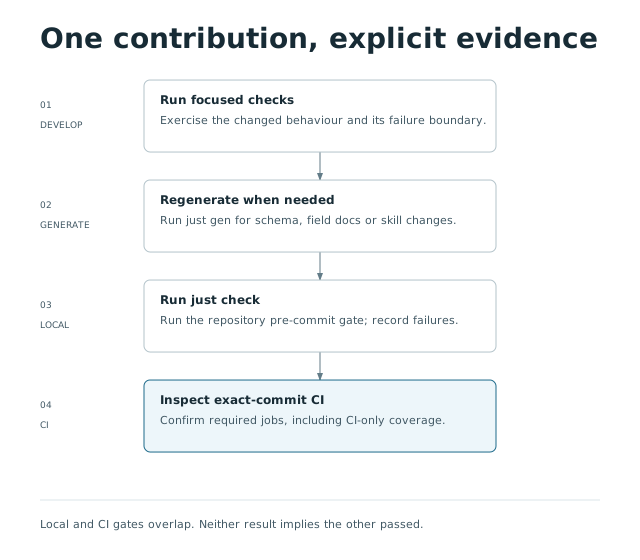
Open the diagram at full size.
just check is the pre-commit gate. Its dependencies in the justfile are authoritative; do not maintain a copied checklist of every recipe. It includes the full plain Go suite and a slow race suite. The race recipe deliberately excludes internal/integration for runner memory limits; that package is still covered by the plain suite. The race recipe also splits out the bound-sensitive tests listed in scripts/race-isolated.txt: the parallel sweep skips them and they run once afterwards, grouped by package, in a go test -race -v invocation. The HA subprocess tests have sub-second lease and renewal bounds; the Agent Observability lifecycle engine tests have 4 s and 20 s caller budgets, which they probe and log as deadline-margin after each engine return. A separate package aggregate resource-bound rule admits exactly three measured dominant teardown-forecast tests: admitted constructions, deactivation and bound dominance. Repeated large-state work pushed the hosted package past Go's default 600 s deadline even after the decoder shortcut; this is not caller-margin admission or evidence that an individual test hangs. These three join the existing isolated invocation for that package, preserving every test case, -race, caller bound and the default 600 s timeout in both invocations; other forecast tests stay in the sweep. To isolate another package's tests, add lines to that file; just race-split-check (part of just check) proves each listed test runs exactly once and that every test whose own body calls the deadline-margin probe is listed (a test reaching the probe only through a helper is not detected, so list it by hand). Run focused checks while iterating and the full gate on the final candidate. Read the repository agent instructions for change-specific slow tiers, such as the disposable collector capture lab.
just ci adds Docker-backed checks and a full-history secret scan, so it requires a full-depth checkout and a working daemon. It is not an exact reproduction of hosted CI: GitHub also runs Kubernetes schema validation through shared workflows, while some local acceptance recipes are not part of its main CI workflow. Consult .github/workflows/ci.yml for the hosted job set and required result. A local pass does not replace CI on the submitted commit, and CI is not proof of live Grafana delivery.
If a gate cannot run, report the command, reason, and checks that did run. A maintainer may agree to an explicit CI-first exception; never infer one or report an omitted local check as passed. Do not change timeouts, exclusions, or fixtures just to obtain a green result.
Agent and human review
Agents use the bundled contribute skill, which routes to this guide and the same recipes. The repository agent instructions define when specialist skills apply. Skill usage alone is not evidence: include actual command outcomes and remaining gaps.
Public contributors submit a focused pull request and use the project's hosted checks and review process. Maintainers also use CodeRabbit CLI review under their own configured policy; contributors are not required to obtain a personal paid CLI account or reproduce private maintainer tooling. Do not upload credentials or customer identifiers to any review service. Review and correct the final diff before reporting completion, and use the PR template to summarize the evidence.
Live deployment, provisioning, and telemetry destination changes are separate operations. In particular, recipes with confirmation prompts must not be made unattended by passing --yes.